Using BEAGLE-AGN to study AGN contribution in GHZ2 at z = 12.34
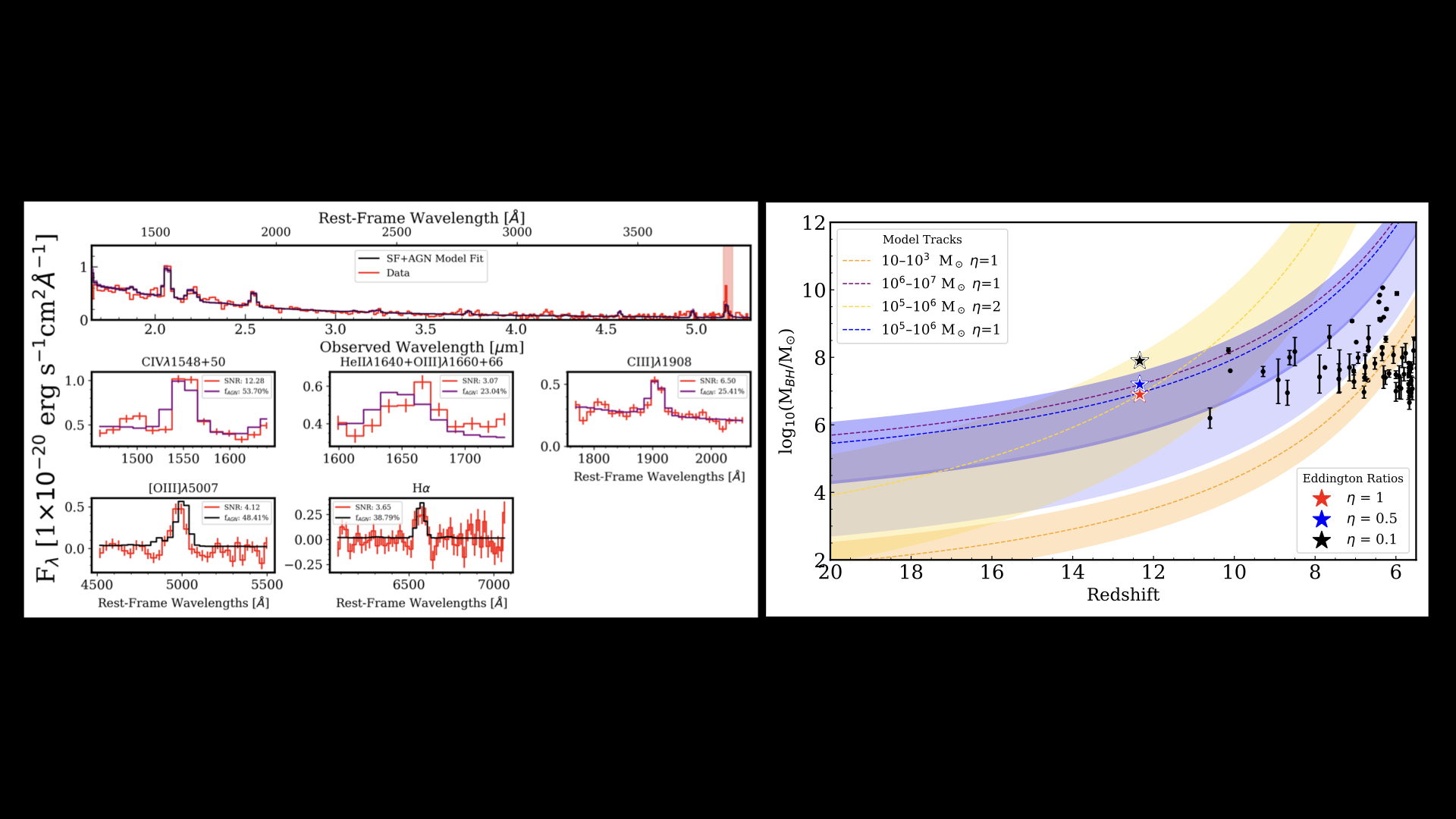
We analyzed the high-redshift galaxy GHZ2 to understand the origin of its strong high-ionization UV emission lines. Using the BEAGLE-AGN SED fitting code, we separated the contributions from stars, nebular gas, and an active galactic nucleus (AGN).
Key Findings
- The best-fit model requires both star formation and AGN activity, with the AGN contributing roughly 54% to CIV 1548 and 26% to CIII] 1908. Other lines also show significant AGN contributions.
- Stellar-only models cannot reproduce the strongest UV lines, confirming the need for an AGN component.
- Estimated black hole mass ranges from ~8 million to ~800 million solar masses, depending on the assumed accretion rate.
- The black-hole-to-stellar-mass ratio is unusually high for this epoch, supporting early black hole formation scenarios.
- Languages: Python, AstroPy, Pandas,
- Publication: NASA ADS Link
Factors Influencing Lyman-Alpha Escape in MOSDEF Galaxies
We analyzed galaxies from the MOSDEF survey to understand what properties facilitate the escape of Lyman-alpha emission, comparing galaxies detected in HETDEX to those without detected Lyman-alpha.
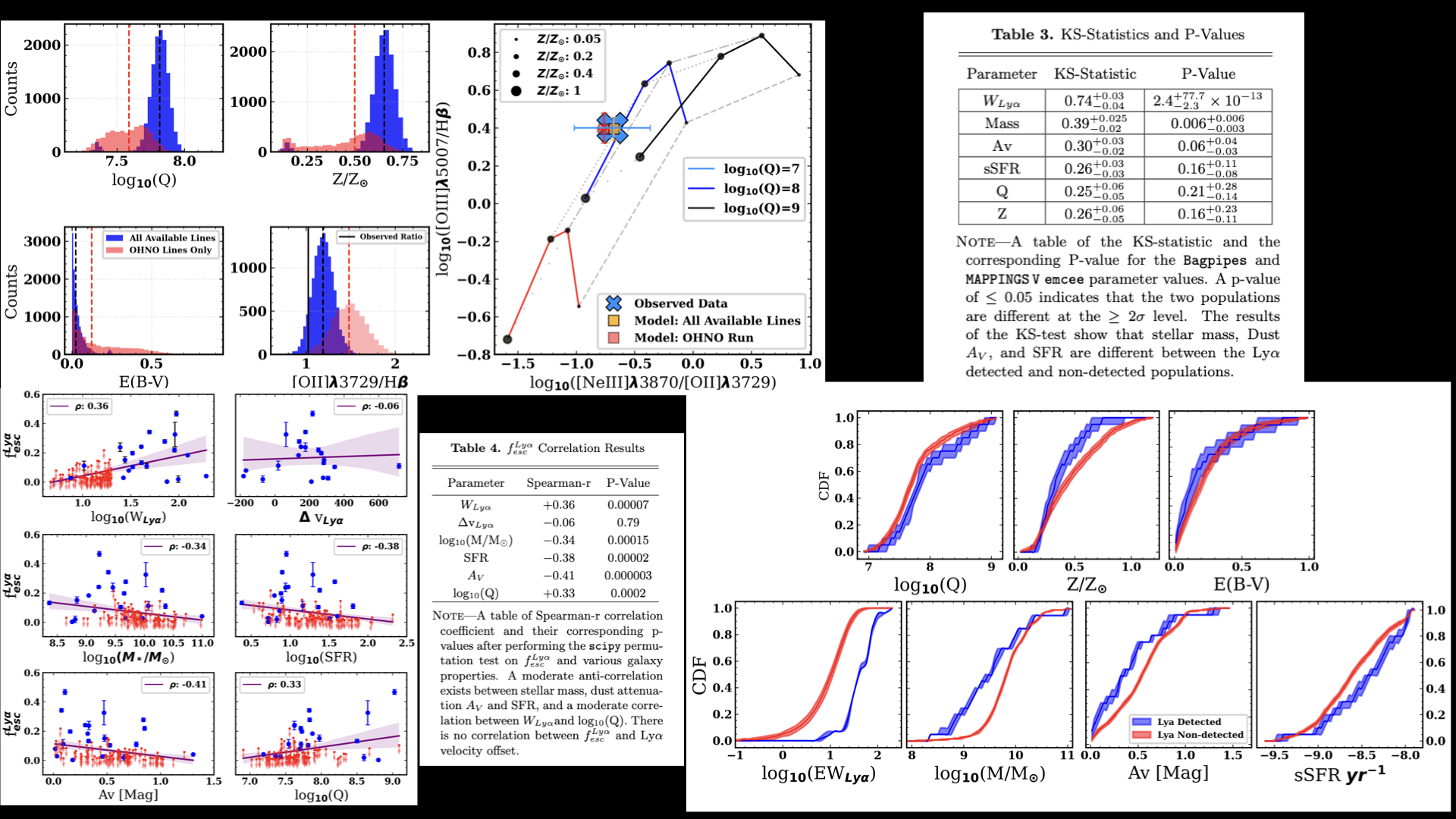
- Lyman-alpha detected galaxies tend to have **lower stellar mass** and **less dust attenuation**, both with high statistical significance. They also show hints of **higher ionization parameters** and **lower metallicity**, though differences in sSFR are not significant.
- The **Lyman-alpha escape fraction** is moderately anti-correlated with stellar mass, star formation rate, and dust content, and positively correlated with the ionization parameter. This underscores the importance of internal ISM conditions and ionizing radiation in enabling Lyman-alpha photons to escape.
- The **median Lyman-alpha velocity offset** for detected galaxies is ~178 km/s, but no strong evidence suggests that velocity offsets are a primary factor in escape. Sample selection toward high equivalent width galaxies may bias this result.
- Tools: emcee, NumPy, Pandas, AstroPy
- Publication: NASA ADS Link
TESLA Survey: Pilot Study of Lyman-Alpha Emitting Galaxies
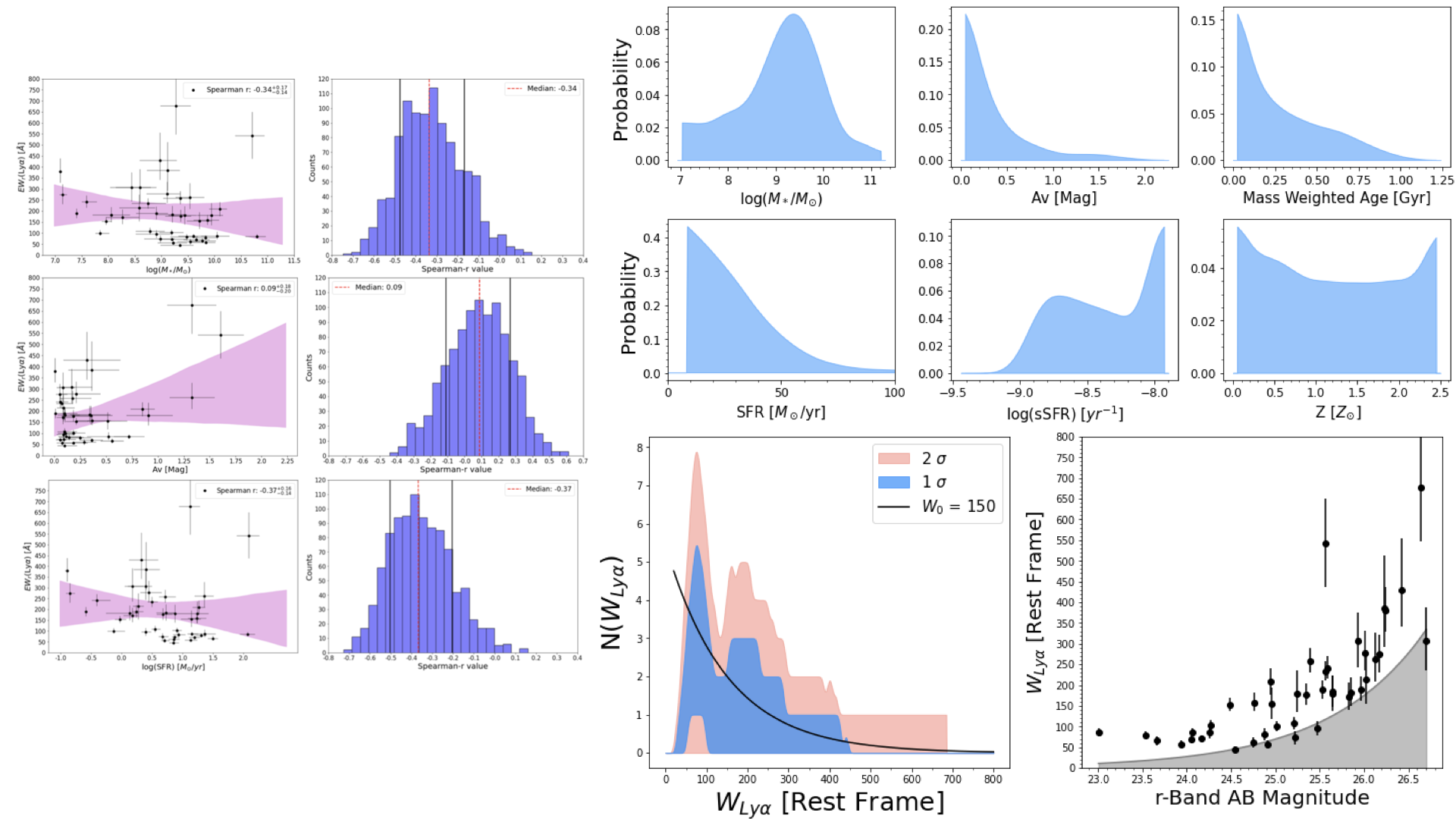
The TESLA survey is a 10 deg² IFU spectroscopic survey in the Euclid NEP deep field, combining imaging and photometry from the HETDEX survey. In a pilot study covering ~194 arcmin², we explored sample selection and early correlations between galaxy properties and Lyman-alpha emission. Using a decision tree algorithm, we identified 43 Lyman-alpha emitting galaxies (LAEs) between z ~ 1.9–3.5 and analyzed their properties with Bagpipes
- TESLA LAEs exhibit physical properties similar to previously studied LAE samples, with the potential to probe a wider range in stellar mass and dust content, highlighting the advantage of unbiased sample selection.
- Stellar mass and star formation rate show the strongest correlations with Lyman-alpha equivalent width, with Spearman coefficients of approximately -0.34 and -0.37 respectively.
- The equivalent width distribution of the TESLA LAE sample is consistent with typical literature distributions, with an e-folding scale of W₀ ≈ 150 Å.
- Tools: Python, Astropy, Pandas, NumPy
- Publication: NASA ADS Link